Tuesday, January 13, 2009

India needs to change its ambiguous land ownership laws

Among the legal inadequacies, unclear land title in big cities is a hazard. Most of the real estate dealings is done on lease for years; even after the land is sold, ownership remains with the government except in Rajasthan, the only state which has introduced guaranteed Land Title Bill to transfer ownership from government to buyers for its cities. The rest of the states remain ambiguous over the issue. Ask any buyer the relevance of guaranteed title or other legalities! One Day India will be like this..Developers require a hundred different authorisations which take three to five years on an average; enough to destroy anyone’s motivation! Moreover, stamp duty in India is very high (over 10 per cent) compared to the rest of the world (2 per cent). This, on one hand restricts demand, and on the other hand, increases property cost. Property tax is a mere 0.002 per cent whereas the world average is 1.5 per cent. This gives the government scope to easily increase its revenue by hiking it a little further, as it is a primary tool for government to generate revenue.
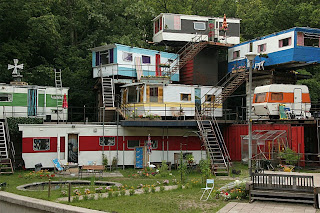
Considering all these, there is one thing clear: government alone can not provide housing to its populace, the country needs strong participation from private players and that can only be possible by better transparency and adequate reforms initiation, at least on the above stated issues. A few states’ individual effort might work as a catalyst but India needs a centrally-motivated holistic approach. Will that be possible in this land of disparity? ....Continue

Labels: , , , , , , ,

Friday, January 09, 2009

The outcome of the Assembly polls in five states has thrown up important lessons for all major political parties as they head for the general election

All this has emboldened BSP chief Mayawati to strike a harder bargain with its allies in seat adjustment talks for the parliamentary elections coming up next year. She has already been projected as the prime ministerial candidate by Left Front leaders Prakash Karat and AB Bardhan. And now with TDP chief Chandrababu Naidu and AIADMK president J Jayalalitha tying up with the Left parties, the ground is ready for the proposed Third Front.


The BSP’s emergence has clearly underlined the fact that the General Elections won’t Manmohan singh and Sonia Gandhibe a two-horse race; and if Mayawati throws her lot behind the comrades, this Third Front could well be in a position to take a shot at power as well.

Another revelation from the just concluded Assembly elections is that a potion of good governance, development, rapport with the electorate and a cohesive party campaign makes a winning mix that is quite capable of negating the anti-incumbency factor.

Indeed, it was this same concoction that helped Sheila Dixit in Delhi, Shivraj Singh Chauhan in Madhya Pradesh and Raman Singh in Chhattisgarh. Is Vasundhara Raje listening? If she failed to retain the gaddi in Rajasthan despite massive development during her tenure and her impressive electorate-connect, it was primarily because she neglected her own party. The state party chief Om Mathur admitted as much when he told TSI that there was a “communication gap” between the party and the government till he took over in January. While the party sought to keep her reined in, Vasundhara wanted a free hand. This much was evident in her opposition to RSS pracharak (preacher) Mathur’s appointment as state BJP president in place of her own favourite Mahesh Sharma. Relations between the party and the government had deteriorated to the extent that officials of a public relations company hired to oversee the BJP’s campaign acted as messenger between Mathur and Vasundhara. The lack of consensus saw fierce arguments during candidate selection and propping up of 75 rebels against the party’s official nominees. The BSP factor and the BJP’s anti-terror rhetoric post-Mumbai attacks too failed to salvage Vasundhara’s fortunes.....Continue

Labels: , , , , , , ,

Wednesday, January 07, 2009

Kremlin steps up political ties in Latin America

Chavez and Medvedev met on board a Russian warship harboured in a Venezuelan dock ahead of combined military drills. Medvedev said Russia is stepping up its political ties in Latin America and said Moscow must insistently seek out to shore up its financial position in the region. "One must admit, to put it simply, we have never had a serious presence here – Chavez and Medvedev these have been just episodes," he told reporters in Cuba, referring to Latin America. "We visited states that no Russian leader, and no Soviet leader, ever visited. This means one thing: that attention simply was not paid to these countries," he said.

"This is evidently a thrust to swell Russia's sway on the world stage," Andrew Neff, an analyst with IHS Global Insight, told TSI. “Even though Russia was pursuing energy collaboration with Venezuela, the actual benefit was in spreading political authority more willingly than any apparent economic return.”

In fact, Latin America’s intercontinental ties have for long been more assorted than caricature permits, but they are becoming even more so as the globe transforms. For some South American nations, Europe has at all times been in any case as significant as a trade and venture partner as the United States. Trade with Japan and the Middle East grew in the 1970s, while the Soviet Union sold arms to Peru as well as sustaining communist Cuba.

For the Kremlin, this is tantamount to sending Washington a memo: if you intrude in our backyard, we'll intrude in yours.....Continue

Labels: , , , , , , ,

Friday, January 02, 2009

…and yet, peace must prevail!

Pakistan President Asif Ali Zardari might be looked upon with suspicion due to his tainted background, but his recent statement that Pakistan is not threatened by India speaks volumes of his statesmanship. It not only points to an urge to forego jingoism that have clouded the relationship between the two neighbours for 61 long years but also indicates that he has the courage and desire to bring drastic changes in Pakistan's foreign policy that has so far been based on paranoia and mistrust towards India.

However, the reign of terror let loose in India's financial hub Mumbai have temporarily dampened hopes of lasting peace between the two nations who have fought three deadly wars since they achieved independence in 1947 and provided an opportunity to warmongers to unleash hatred and misunderstandings yet again.

It has also generated media hype in Pakistan and India, especially in electronic channels where cooked up stories continue to be aired unabashedly. For instance, Pakistan's military spokesman Major General Athar Abbas was quick to clarify on November 30 that the army has not seen any unusual movement of the Indian troops on the border so far and the situation on the Indian border was normal. The Indian Foreign Ministry also rejected Indian media reports that it was considering suspending the Line of Control ceasefire agreement with Pakistan and increasing troops on borders. The restraint shown by the Indian government is a welcome sign. More so because despite mayhem in Mumbai and the subsequent anger, India has not amassed troops on Pakistan borders as it did in 2002 when its parliament was attacked by terrorists. The patience was also evident when the Indian embassy in Kabul was attacked a couple of months ago.

In an interview with The Financial Times on December 1, President Zardari said: "Such a tragic incident must bring opportunity rather than the defeat of a nation. We don't think the world's great nations and countries can be held hostage by non-state actors." Zardari warned that militants had power to precipitate a war in the region. "Even if the militants are linked to Lashkar-e-Taiba, who do you think we are fighting?" asked Zardari....Continue

Labels: , , , , , , ,

Monday, December 22, 2008

Storm over Jallianwala Bagh

Just Imagine the grandson of a Jallianwala Bagh veteran visiting the site where hundreds of Indian patriots had lost their lives to British brutality at Amritsar, Punjab, during the freedom struggle. Imagine the plight of a grandson who has heard from his grandfather what was there in the monument to the historic event, that turned the tide of the Indian freedom struggle. Imagine yourself, as one such grandson, almost hearing the fading, aged voice of your grandfather, and then keen to come and see if what he had said was there, but you could not find it: Reason? Government renovation of those of others like him. Damned, the beloved country’s governance!

Jallianwala Bagh is not just another recreational spot for tourists, but a ‘sacred’ place today. This public park, close to the Golden Temple of Amritsar, witnessed a massacre on April 13, 1919. It was meant to be a peaceful public meeting for the Baisakhi festival, to assert the right of people to assemble and protest, which was curbed by the martial law imposed by the then Lieutenant Governor of Punjab, Michael O’ Dwyer. Many in the assembly were just people who had come to say morning prayers at the Golden Temple. Soon after the meeting started, Brigadier-General Dyer opened fire on an unarmed gathering of 25,000 men, women and children. The firing lasted about 10 minutes and 1650 rounds were fired, or 33 rounds per soldier and hundreds were killed by the bullets while others fell into the well trying to escape and many were hurt in the stampede.

The renovations are fraught with problems, even as the work is in full progress. The reason for protests by historians and freedom fighters is that some of the important historical relics are being lost in the process. Terming the renovation of historical lanes of Jallianwala Bagh as defacement and destruction of the historical monument, president of Desh Bhagat Yadgar Hall Committee 101-year-old Ghadri Baba Bhagat Singh Bilga has sought the intervention of the Prime Minister in the case. “The two already demolished historical lanes of Jallianwala Bagh should be reconstructed, and the third one should not be razed in the name of widening the entry point for VVIPs’ vehicles,” says a vocal critic.....Continue

Labels: , , , , , , ,

Thursday, December 18, 2008

Advantage Jamaat-E-Alliance

After working for decades towards building a society in India based in Islam, Jamaat-E-Islami recently announced its intentions to float its own political party. The announcement made by Mustaq Farooq, the all India general secretary of this semi-political and religious organisation, has undoubtedly created quite a stir among the political circles in Kerala. The new outfit’s general approach towards politics will be to side with the Left parties whenever BJP has a winning chance and support the Congress-led UPA wherever the Left Democratic Front (LDF) does not have any effective influence.

Jamaat’s Kerala leaders say the new outfit will be launched only after the Lok Sabha elections; media speculations meanwhile peg the launch date as January 2009. The decision is likely to be taken during a conference in Kochi to be held soon as a part of the organisation’s national Amir’s all India odyssey.....Continue

Labels: , , , , , , ,

Wednesday, December 17, 2008

The old tiger still roars

25 kilometres from the Indo-Nepal border, framed against the Terai forests of Lakhimpur Kheri, stands a lonely house… and here they say, an old tiger still roars.

The house was empty. Rising flood waters of the Soheli had claimed these lands for long this season and while the waters had receded, the old tiger hadn’t returned yet to his Haven. On the verandah, next to stacks of mouldy books, throwing a silent challenge, rolled a solid iron barbell, loaded thick with weighted plates. I succumbed to the lure and gripped the cold steel bar and heaved. Nothing happened… I heaved again, and it moved a few reluctant inches before I gave in to gravity and let the barbell clang to the floors. “Sahab roz uthathe thhey, till about 8-10 yrs ago”, said a voice. It was the caretaker. That weight must’ve weighed many hundred pounds and ‘Sahab’ was supposedly 91 now. I wondered about the veracity of the legend. ‘Sahab’ wasn’t here though. He’d moved a few kilometers south, and we followed. I remembered what a local zamindar had said. “He isn’t very tall but used to be a very strong man. He once picked up the front axle of a tractor. Even today his arms are in better shape than yours or mine”. Then I saw him on the front porch of his house, a frail little man curled up on a high chair, a gentle smile welcoming us. He motioned for us to sit and the first thing I asked him was if he’d really picked up the tractor. “Just stories…”, boomed the man’s voice and then he shook my hand with an iron grip that suggested that these ‘stories’ must ring true… surely, the old tiger still roars.

‘Billy’ Arjan Singh is what they called him in the early days when he went about trying to be ‘The Corbett of Kheri’ as he put it, but today he prefers just plain Arjan Singh. Tracing his lineage to the royal family of Kapurthala and Anglo –Bengali Christians, ‘Billy’ loved the great outdoors. He wrestled, lifted weights and in keeping with his heritage, made friends with the hunting rifle rather early in life. He killed his first leopard at 12 and his first tiger at 14. In fact, he was quite a blood thirsty little butcher in those days, killing every possible animal within the range of his rifle. On one occasion he and his brother were returning from the forest in a car and saw a hyena loping across. They fired at the unhappy beast till they ran out of bullets. Then they tried to run the animal over and yet the suffering animal wouldn’t die. There are tales a plenty of his ‘callous brutality’ as he puts it in one of his books. And yet, the forest had claimed his soul and with each animal he killed, he felt a little emptier inside until the day he realised that he killed not for the joys of the hunt as much as he killed to quiet his own feelings of inadequacy. Since then, he has ruthlessly denounced his own weaknesses that had made him into a wanton killer. Today, as the crops stand in his fields, he tells his farm hands that the animals have first right to these crops and there would be enough for all. And sure enough, there is. There’s a sadness in those eyes when he talks of that same blood lust, greed and human insecurity that he once felt, which still turns men into poachers and forests to fallow land, but he hasn’t given up the fight… the old tiger still roars.....Continue

Labels: , , , , , , ,

Saturday, December 13, 2008

'Descent'ralisation?

The fight for decentralisation and hence, more power in the hands of the state governments, has been a pertinent case for long. For decades, several Indian states have blamed the partisan politics and the bias of the Indian central government for the lack (or stalling) of development in their respective territories. Therefore, over the years there has been significant devolution of central power in favour of the states. For ministries like panchayati raj, education, agriculture and rural development, while the money has been sanctioned by the respective Central ministries, the onus was definitely lying with the state governments as to how the money given is to be spent in the said financial year. Yet, with the passage of time, it is highly evident that anything controlled and monitored by the Central government has been rightly tackled, thereby, yielding better results. For example, consider the national highways constructed and maintained by the nodal agency called National Highway Authority of India.

The quality and smoothness of these national highways stand in stark contrast to the piteous conditions of the state-owned ones. Also, the conditions of the municipality-managed-city-roads are far from "better". Most of India’s blue chip PSUs like NTPC, ONGC, IOCL BHEL, Nuclear Power Corporation and SAIL, or banks like SBI, Bank of Baroda and Allahabad Bank, or research organisations like DRDO, ISRO, BARC and CSIR are centrally owned. Now, opposing these centrally branded varients are the many inefficiently run state government corporations (barring most Gujarat PSUs) that barely witnessing any profit inflow....Continue

Labels: , , , , , , ,

Friday, December 05, 2008

The Genial Giant

Isaw Anil for the first time at a coaching camp that the Karnataka State Cricket Association used to conduct. That’s almost more than two decades back. To be honest, the very first thing that came into my mind when I saw Anil was that maybe “this boy is gifted with the ultimate talent, and definitely he is going to be a gem for Team India." He was the ‘fast bowler’ from the beginning. When he bowls, he never flights the ball. Instead, he bowls it fast. There is more zip than there is spin. The thing which made me observe Anil in the coaching camp was that his style of bowling was quite similar to mine. He was and is very good at line and length, and a very accurate bowler from day one.

If Anil has become a legendary cricketer, it is just because of his determination, hard work and ultimate patience. Though I could not keep a perfect track of how Anil as a bowler moved further (during the time, I was bed-ridden for five years), but on and off, I watched him all along. I can say he still bowled in the same style and manner that he used to bowl before. He must also have been told to change his bowling action, as he doesn’t spin much, but having a tremendous grip on the ball, he bowls fast. Anil’s greatest strength is his never-say-die attitude. He never ever quits. He never gives up the challenge. If Anil cannot do it today he will think hard about how to make it possible tomorrow.

According to me Anil is the world’s best spinner. There would be no second word about it. He has proved it often. As a bowler Anil has won more matches than any other bowler for India. India has won every match where Anil performed well. The self confidence and control he has is a lesson for every one.....Continue


Labels: , , , , , , ,

Monday, December 01, 2008

One-upmanship swamps nascent 'Bihari Pride' campaign

IIPM Publication
Speaking from Jhanjharpur, RJD MP Devendra Prasad Yadav told TSI: “These resignations have made politics a joke, and Nitish Kumar has merely decided to break out unity. On October 27, all our parties had decided to work together, but this step has broken that promise. Ideally the MPs of all three parties should have resigned together. This is not a small issue. It is a question of the unity and
sovereignty of the country.”

Paswan has termed this a political gimmick. “Who does not know that the terms of the MPs would in any case end within the next three months? Meanwhile, ‘inspired’ by Nitish’s step, even the RJD MPs have sent in their resignations to party boss Lalu Prasad. The big question is, why give it to Lalu, why not to the Lok Sabha Speaker? Is this an RJD’s answer to Nitish’s gimmick?....continue

Labels: , , , , , , ,

Friday, August 08, 2008

The 4Ps B&M and ICMR Best Marketed State Survey 2008


IIPM Ranked No. 1 B-School In Global Exposre - Zee...

Well, the list showcases a minor percentage of real estate investors as well. This primarily because the MP government has a host of sops and policies which make investments appear lucrative for the investors in this format. They give concessions for entry tax exemption, interest subsidy, ISO-9000 expenditure reimbursement and a state investment subsidy. The IT industry additionally receives a separate set of concessions, which also includes a concession to project report cost reimbursement. However, there are still some players which are wanting more from the government (perhaps a reason why MP is not numero uno). One of them is Bikanerwala Foods Pvt. Ltd., which has not set up a plant in MP yet. Chetan Agarwal, Director, Bikanerwala Foods reasons, “The government has been supporting, but due to certain internal reasons, the company has decided to hold back its investment plans in the state...”

Apart from wooing investors, the state has also successfully attracted a large number of tourists, count of which is set to improve drastically owing to future investments as Lohani of MPSTDC predicts, “The investments in the tourism sector is also picking up radically and will fast increase over the coming years. This will give a push to tourist influx in MP...” Last year, the state budget for tourism was Rs.82 crore. It also received 4 national awards for its efforts towards improving tourism. The state has carried out a highly professional and aggressive promotional campaign for the state in print, radio and TV media, with some of the country’s best tourist spots like Chanderi, Kanha, Khajuraho, Pachmarhi, Ujjain, Sanchi to boast about! The state authorities for tourism has adopted innovative measures like cruises on large water bodies, specially designed sight seeing buses, & rail coach restaurants at Bhopal to add that touch of add-ons when it comes to attracting footfalls. All said and done, with investments flowing in thick, MP is more a haven for the ‘Capitalistic’ tourists; though there’s something for leisure lovers too!

For more articles, Click on IIPM Article.

Source : IIPM Editorial, 2008

An Initiative of IIPM, Malay Chaudhuri and Arindam chaudhuri (Renowned Management Guru and Economist).

Read these article :-
ZEE BUSINESS BEST B SCHOOL SURVEY
B-schooled in India, Placed Abroad (Print Version)
IIPM in Financial times (Print Version)
IIPM makes business education truly global (Print Version)
The Indian Institute of Planning and Management (IIPM)
IIPM Campus

For More IIPM Info, Visit below mentioned IIPM articles.
4Ps Power Brand Awards 2007
When IIPM comes to education, never compromise
IIPM, GURGAON
IIPM - Admission Procedure
IIPM is A World of Career
Why Study Abroad When IIPM Gives You 3 global Advantages!


Labels: , , , , , , ,

Monday, July 21, 2008

Have kal par control?


When IIPM comes to education, never compromise

Live ‘retired’ life king size with Aviva Life

The very word retirement sends down shivers through the entire body. People literally shy away from this inevitable truth that one day they too have to lead a retired life – full of boredom, without any work et al. What’s more? Surprisingly figures indicate that close to 57% of pre-retired Indians think that they will work beyond their retirement age to fund their retirement, a rise of 17% from 2004. And that’s not all. Over 45% Indians do not know where to seek financial advice from and little over a half admitted to being in the dark over pensions and saving policies with a sizable number turning to the internet for help. Appalling figures these. But then these are the results of ‘The Aviva Customer Attitude to Savings Survey,’ spanning across three years from 2004-07. The survey, one of the largest of its kind in the financial services sector, was conducted by Aviva and HCHLV, Aviva’s international research partner. States Bert Paterson, MD & CEO, Aviva India, “It is heartening to find that Indians continue to save keeping the future in mind. While savings is important, retirement too is a serious issue. Only 4% of the GDP of India is spent on insurance and at the dynamic pace at which India is moving, people need protection.”

Aviva’s effort to pull people towards insurance may pay off in the long run but will surveys like this make a real impact on the general public? Aviva through its advertising too has been emphasising on the importance of retirement planning. The insurance company has recently roped in Sachin Tendulkar as its brand ambassador to talk about its various schemes. So if you want kal par control, you know where to go, don’t you?

Research bureau: Pawan Chabra

For more articles, Click on IIPM Article.

Source : IIPM Editorial, 2008

An Initiative of IIPM, Malay Chaudhuri and Arindam chaudhuri (Renowned Management Guru and Economist).

Read these article :-
B-schooled in India, Placed Abroad (Print Version)
IIPM in Financial times (Print Version)
IIPM makes business education truly global
The Indian Institute of Planning and Management (IIPM)
IIPM Campus

For More IIPM Info, Visit below mentioned IIPM articles.
IIPM, GURGAON
IIPM - Admission Procedure
IIPM is A World of Career
Why Study Abroad When IIPM Gives You 3 global Advantages!


Labels: , , , , , , ,